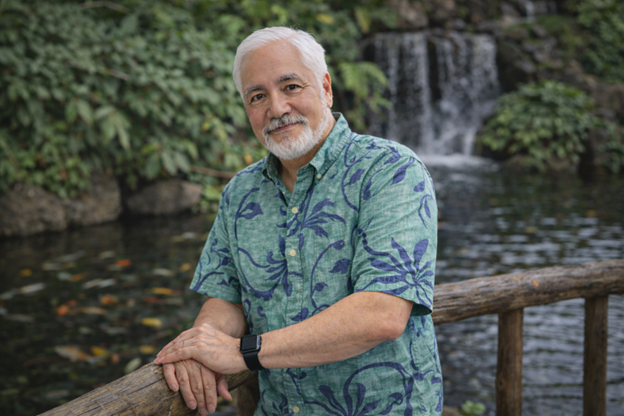
About John
John K. Tsukayama, PhD, CFE (Ret.), is a Native Hawaiian author, investigator, and educator whose work explores questions of purpose, moral choice, power, and responsibility—both in ordinary lives and at the outer edges of human conflict.
He was raised in Hawaiʻi, where values of family, obligation, and place shaped his understanding of service and accountability from an early age. Over a professional career spanning more than four decades, he conducted and supervised hundreds of high-stakes investigations involving fraud, corruption, misconduct, and abuse of trust in both public and private institutions. His work ranged from corporate and financial investigations to some of the most consequential public-interest inquiries in Hawaiʻi history. In addition, he and his team managed sensitive high-stakes engagements to steer potential worst-case targeted violence toward peaceful, and quiet, outcomes.
Tsukayama is a retired Certified Fraud Examiner and former former Certified Protection Professional and former Professional Certified Investigator.
In the wake of his investigative career, Tsukayama pursued academic research into political violence, counter-terrorism, and the moral limits of state power. His scholarship examines torture, killing, and coercion in modern conflict—not as abstractions, but through the lived experiences of those asked to carry out these acts. This work culminated in By Any Means Necessary: Veterans Talk Torture in the War on Terror, a deeply human account of moral injury, obedience, and consequence.
Tsukayama holds a PhD in International Relations from the University of St Andrews in Scotland, where his research focused on political violence and coercive state practices. He also a Master of Letters in Terrorism Studies from the Centre for the Study of Terrorism and Political Violence. He holds a Bachelor of Arts in Interdisciplinary Studies (Political Science/History) from Brigham Young University—Hawaii. He has taught university-level courses in international relations, criminal justice, investigative methods, threat assessment, and political philosophy. His teaching emphasizes critical thinking, evidence-based reasoning, and the responsibility that comes with power and authority.
In contrast to his academic and investigative work, Lived With Purpose is a personal memoir written for his children and grandchildren—and for readers navigating their own questions of meaning, integrity, and resilience. It reflects on family, faith, humor, failure, and the quiet decisions that shape a life. Though very different in tone from his scholarly work, both books are grounded in the same conviction: how we live, choose, and treat others matters—especially when no one is watching.
Tsukayama is also the co-author of The Process of Investigation with Charles Sennewald, an authoritative book on criminal and corporate investigations in the private sector.
John lives in Hawaiʻi with his wife in a multigenerational household surrounded by children, grandchildren, and extended family. When not writing or teaching, he can often be found cooking for family gatherings, mentoring former students, or telling stories on the lanai—still guided by the belief that a life of purpose is built one deliberate choice at a time.
“Live with purpose. Live with integrity.”