What Readers Have Said About Lived With Purpose
“Incredibly moving, deeply troubling, surprisingly inspiring—and often embarrassingly funny.”
Stories that wrestle honestly with life-and-death and ends-versus-means dilemmas.
A rare mix of moral seriousness, humanity, and humor.
Engaging stories with real purpose—thoughtful, meaningful, and easy to share with others.
“This book made me think deeply about the legacy we leave and the example we set.”
Selected reader responses from early reviews and private correspondence
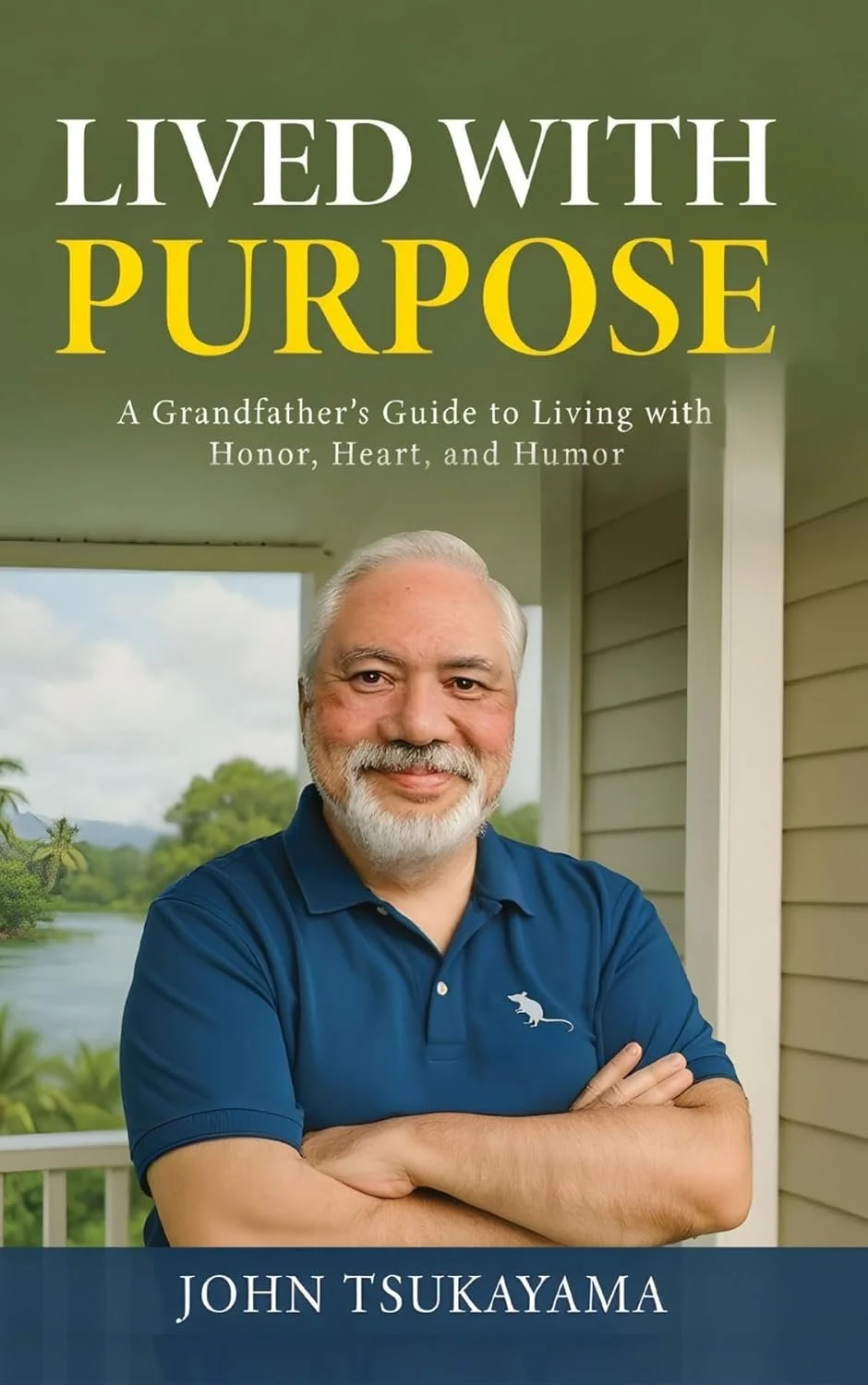
Lived With Purpose
A Grandfather’s Guide to Living with Honor, Heart and Humor
by John Tsukayama
True stories about integrity, consequence, and the choices we carry forward.
Moving, troubling, surprisingly funny, and deeply human—stories with real stakes and lasting lessons.
Lived With Purpose is a reflective memoir built from true stories about responsibility, integrity, and the quiet choices that shape a life lived close to consequence. Written initially for the author’s grandchildren—those living now and those yet to be born—the book is also intended for anyone who may one day face difficult decisions, moral uncertainty, or moments when the right path is neither obvious nor cost-free.
The stories are grounded in lived experience rather than abstraction. They include childhood lessons shaped by Hawaiian practices of hospitality and obligation; family expectations that carried both warmth and weight; and the unspoken rules about showing up for others even when it is inconvenient or costly. Hospitality appears not as sentiment, but as discipline—an ethic that governs how one lives among family, neighbors, and strangers.
Other chapters move into more difficult terrain. Drawing from a professional life spent in investigation and threat management, the book recounts encounters with people at their most exposed: criminals who chose to confess, sometimes haltingly and at personal cost; witnesses and informants who risked livelihoods, reputations, and safety to tell the truth; and individuals caught inside institutions that demanded silence or complicity. These stories involve credible threats, real victims, and decisions made with the knowledge that failure would carry lasting consequences.
Some chapters record conversations with people who had committed grave harm—torturers and abusers who, in rare moments, set aside performance and bared their souls. These encounters are treated neither as absolution nor spectacle. The book does not look away from cruelty, nor does it deny the humanity of those who committed it. Moral injury appears here not as theory, but as lived experience—carried by victims, perpetrators, and those tasked with listening and judging.
But Lived With Purpose is not a book of unrelieved darkness. Threaded throughout are moments of warmth, humor, and self-deprecation: domestic mishaps, absurd situations, family rituals, and the quiet joy of belonging. These moments are not a distraction from the harder material; they are what make endurance possible.
Alongside accounts of investigation and threat are stories of everyday people simply doing their best—colleagues acting honorably inside imperfect systems, family members absorbing the costs of demanding work, and strangers whose decency appeared quietly at critical moments. Throughout, the author insists on a consistent ethic: even in darkness, people are worthy of being seen clearly and treated with respect, without illusion and without contempt.
In an unexpected and innovative element, the book also reflects on the author’s use of artificial intelligence as a sounding board and mirror during the writing process—not as an authority or substitute for judgment, but as a tool for testing memory, clarifying thought, and interrogating one’s own assumptions. These reflections raise questions about accountability, self-examination, and how we make sense of our lives in an age of new technologies.
Unlike a traditional autobiography, Lived With Purpose is not organized around achievements or public milestones. It is organized around consequence—how decisions made under pressure shape the life that follows, and how those choices are carried forward into family, work, and example.
At its core, this is a book about legacy—not reputation, but what is passed on through action, restraint, humor, and love. While written with future generations in mind, it speaks equally to readers navigating hard choices now: parents, professionals, educators, investigators, and anyone seeking to live with clarity and purpose when the stakes are real.